
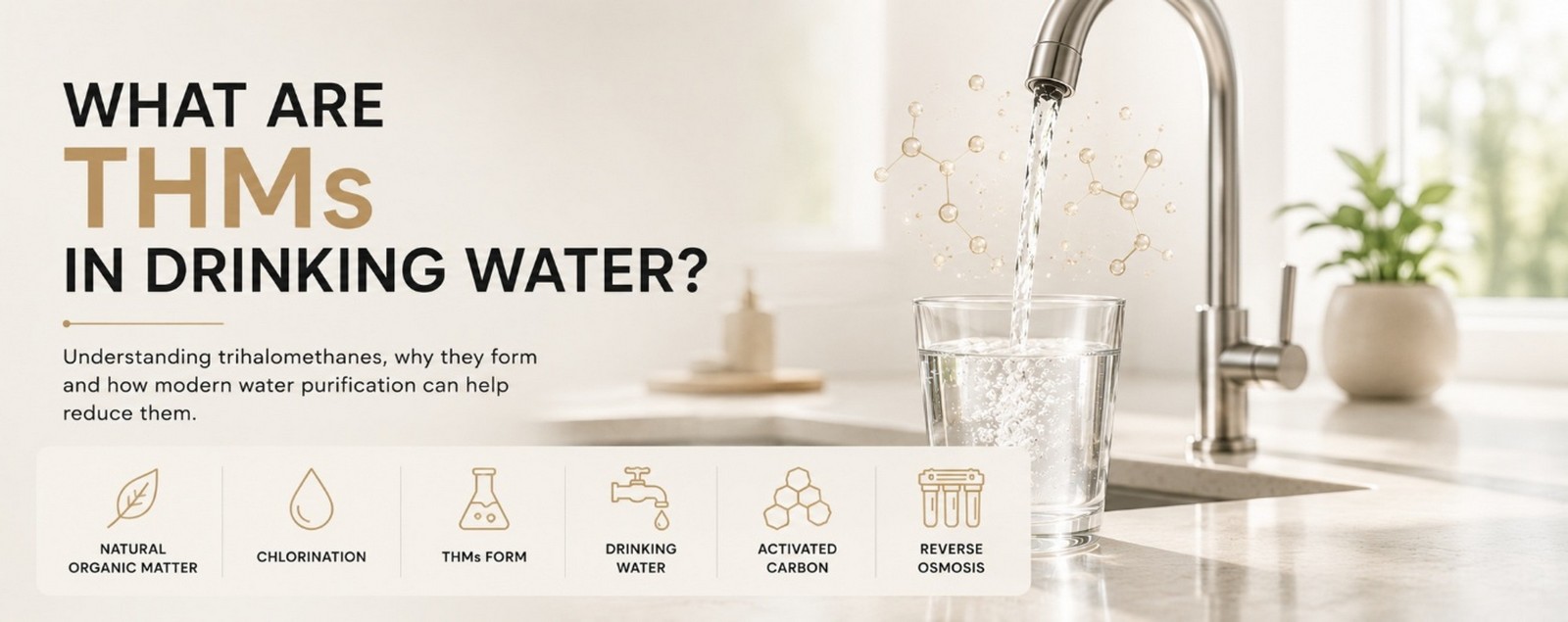
Understanding trihalomethanes, why they form and how modern water treatment can help reduce them.
Learn what THMs (trihalomethanes) are, why they form in chlorinated drinking water and how activated carbon and reverse osmosis can help reduce them.
You’ve probably heard that chlorine is added to drinking water to make it safe.
But did you know that chlorine can also react with naturally occurring material in water to form compounds called THMs, or trihalomethanes?
Although the name sounds complicated, understanding THMs is actually quite straightforward.
Let’s take a closer look.
What are THMs?
THMs, short for trihalomethanes, are a group of chemical compounds that can form when chlorine reacts with tiny amounts of natural organic matter in water.
This organic matter comes from things like:
- Leaves and vegetation
- Algae
- Soil
- Decaying plant material
These natural materials are often present in rivers, dams and reservoirs before the water is treated.
When chlorine is added to disinfect the water, small amounts of THMs can form as a by-product.
Why is chlorine used in the first place?
It’s important to remember that chlorine plays a vital role in protecting public health.
Its primary job is to destroy harmful bacteria, viruses and other microorganisms that could make people seriously ill.
Without chlorine, drinking water would be far more likely to carry waterborne diseases.
In other words, the benefits of disinfecting drinking water greatly outweigh the risks of not disinfecting it.
Why are THMs receiving attention?
Scientists have studied THMs for many years.
Research suggests that long-term exposure to elevated levels of certain THMs may not be desirable, which is why water authorities around the world carefully monitor and regulate them.
The key point is that concern is generally about exposure over many years, not drinking an occasional glass of tap water.
Are THMs found in South African drinking water?
Like many countries, South Africa uses chlorine to disinfect municipal drinking water.
This means THMs can form wherever chlorine reacts with natural organic matter.
Municipal water suppliers monitor water quality to help ensure it meets national drinking water standards, including limits for compounds such as THMs where applicable.
For most households, tap water remains safe to drink.
However, many families choose additional point-of-use purification for improved taste, greater consistency and added peace of mind.
Can THMs affect the taste or smell of water?
Not directly.
The chlorine itself is usually responsible for the familiar “swimming pool” smell or taste that some people notice.
Because THMs form from chlorine reacting with natural organic matter, water with higher chlorine levels may also have a more noticeable taste or smell.
This is one reason why tap water can taste different throughout the year.
Can home water treatment reduce THMs?
Yes.
Different filters remove different types of contaminants.
Activated carbon filters are highly effective at reducing chlorine, which can also help reduce the formation and presence of certain THMs.
Many modern reverse osmosis (RO) systems combine activated carbon with reverse osmosis, providing an additional level of purification while also improving the taste and smell of drinking water.
Why do many families choose home water purification?
Even when municipal water complies with drinking water standards, many homeowners choose to further purify the water they drink every day.
Some of the reasons include:
- Improving taste and smell.
- Reducing chlorine.
- Reducing THMs and many other dissolved substances.
- Producing consistently fresh drinking water.
- Having greater confidence in the water used for drinking, cooking and making baby formula.
Home water treatment isn’t about replacing municipal water treatment—it’s about providing another level of purification at the point where you actually use the water.
The bottom line
THMs are a natural by-product of one of the world’s most important public health measures: disinfecting drinking water with chlorine.
Although scientists continue to study their long-term effects, drinking water authorities around the world carefully monitor THM levels to help ensure they remain within established guidelines.
If you prefer drinking water with less chlorine, improved taste and an additional level of purification, a high-quality home water treatment system can make a noticeable difference.
At SPRYNG, we believe the best decisions start with understanding your water. That’s why our systems combine advanced purification with thoughtful design—helping South African families enjoy fresh, great-tasting drinking water with confidence every day.