
Discover how millions of microscopic pores help reduce chlorine, unpleasant tastes and many unwanted substances from your drinking water.
Learn what activated carbon is, how it works and why it plays such an important role in reducing chlorine, improving taste and supporting advanced home water purification.
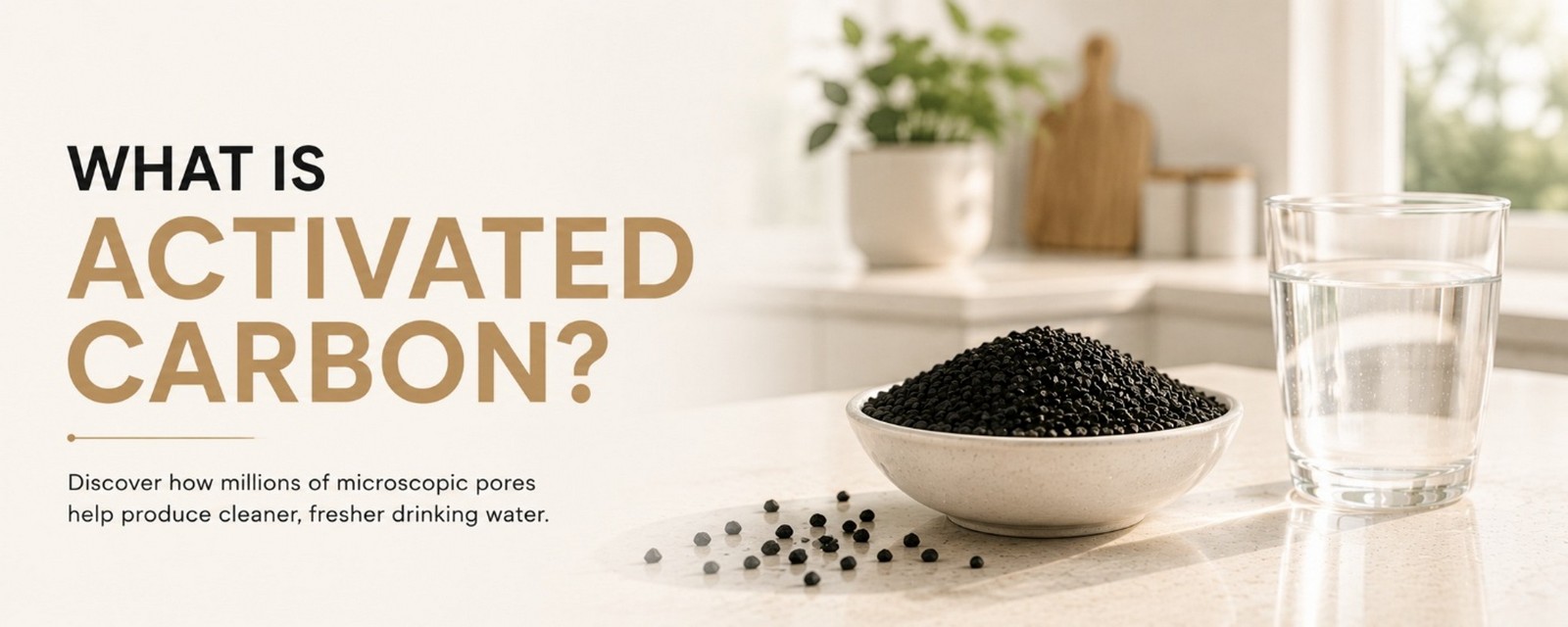
If you’ve ever used a water filter, chances are it contained activated carbon.
It’s one of the most widely used water purification materials in the world and can be found in everything from refrigerator filters and water filter jugs to advanced reverse osmosis systems.
But what exactly is activated carbon?
How does it work?
And why has it become such an important part of modern drinking water purification?
Let’s take a closer look.
What is activated carbon?
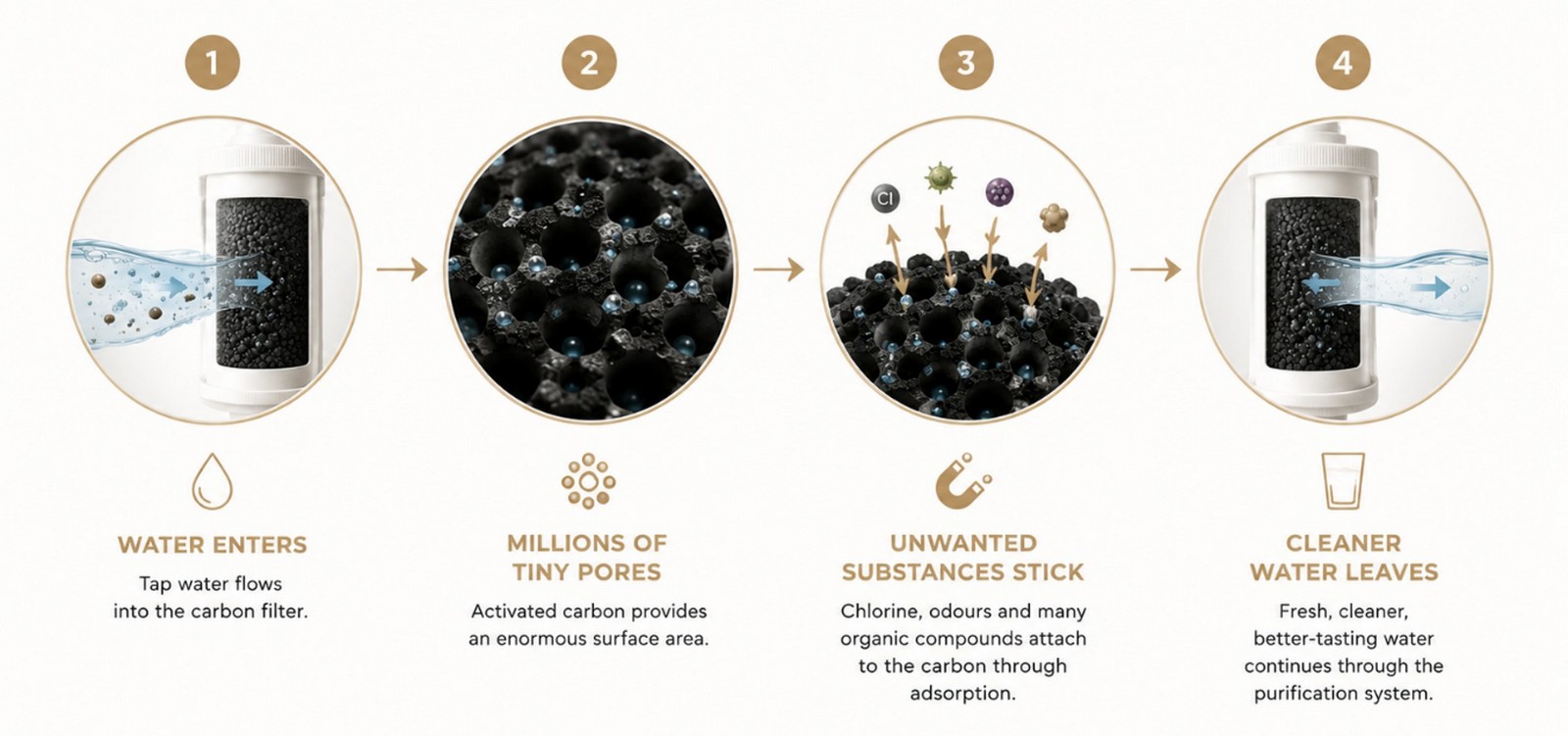
Activated carbon is a specially treated form of carbon that is filled with millions of tiny microscopic pores.
Although it looks a little like ordinary charcoal, it’s very different.
Those microscopic pores create an enormous surface area that can trap many unwanted substances as water passes through the filter.
To give you an idea of just how remarkable it is, just one teaspoon of activated carbon can have a surface area roughly the size of a football field.
This enormous surface area is what makes activated carbon so effective.
What is activated carbon made from?
Activated carbon can be made from several natural materials, including:
- Coconut shells
- Wood
- Coal
- Bamboo
Many premium drinking water systems use coconut shell activated carbon because it produces extremely fine pores that are particularly effective at improving drinking water quality.
How does activated carbon work?
Activated carbon doesn’t work like a kitchen sieve.
Instead, it works through a process called adsorption.
Notice the spelling.
It’s adsorption, not absorption.
With absorption, a substance is soaked up like water into a sponge.
With adsorption, unwanted substances stick to the outside surface of the activated carbon.
As water flows through the filter, many impurities attach themselves to the carbon while the cleaner water continues on its way.
What can activated carbon help reduce?
Activated carbon is particularly effective at reducing substances that affect the taste, smell and quality of drinking water.
These include:
- Chlorine
- Unpleasant tastes
- Unpleasant odours
- Many organic chemicals
- Certain pesticides and herbicides
- Some volatile organic compounds (VOCs)
- Many compounds that contribute to poor taste and smell
- Certain trihalomethanes (THMs)
This is why many people notice that their drinking water tastes noticeably fresher after passing through an activated carbon filter.
What can’t activated carbon remove?
As effective as activated carbon is, no single filter can remove everything.
Activated carbon is not designed to remove many dissolved minerals or salts.
For example, it is generally less effective at reducing:
- Dissolved salts
- Many heavy metals
- Fluoride
- Nitrates
- Total dissolved solids (TDS)
This is why many premium water purification systems combine activated carbon with reverse osmosis (RO).
Each technology performs a different job, creating a much more complete purification process.
Why is activated carbon used before reverse osmosis?
In most reverse osmosis systems, activated carbon is one of the first stages of filtration.
This is important for two reasons.
Firstly, it removes chlorine, which can damage the delicate reverse osmosis membrane over time.
Secondly, it improves the taste and smell of the water before it reaches the RO membrane.
Together, activated carbon and reverse osmosis work as a team—each removing different types of contaminants to produce cleaner, fresher drinking water.
Why is activated carbon used in so many water filters?
Activated carbon has earned its place in millions of homes because it is:
- Highly effective
- Naturally derived
- Safe for drinking water
- Proven through decades of use
- Excellent at improving taste and smell
- An important part of many advanced purification systems
Whether you’re filling a glass of water, making coffee or preparing baby formula, activated carbon helps improve the quality of the water you use every day.
Why do many families choose activated carbon filtration?
Many homeowners install water purification systems not because their municipal water is unsafe, but because they want drinking water that tastes cleaner, smells fresher and provides greater confidence every day.
Activated carbon helps achieve this by reducing chlorine and many of the substances that affect water quality before it reaches your glass.
When combined with reverse osmosis, it forms part of one of the most effective home water purification systems available.
The bottom line
Activated carbon is one of the most important materials used in modern drinking water purification.
Its millions of microscopic pores help reduce chlorine, improve taste and odour, and remove many unwanted organic compounds from drinking water.
While activated carbon is highly effective on its own, it becomes even more powerful when combined with reverse osmosis, creating a multi-stage purification system that delivers consistently fresh, great-tasting drinking water.
At SPRYNG, we believe the best decisions start with understanding your water. That’s why our systems combine premium activated carbon with advanced reverse osmosis technology—helping South African families enjoy beautifully purified drinking water with confidence every day.