
Understanding chlorine, changing water quality and why many families choose home water treatment.
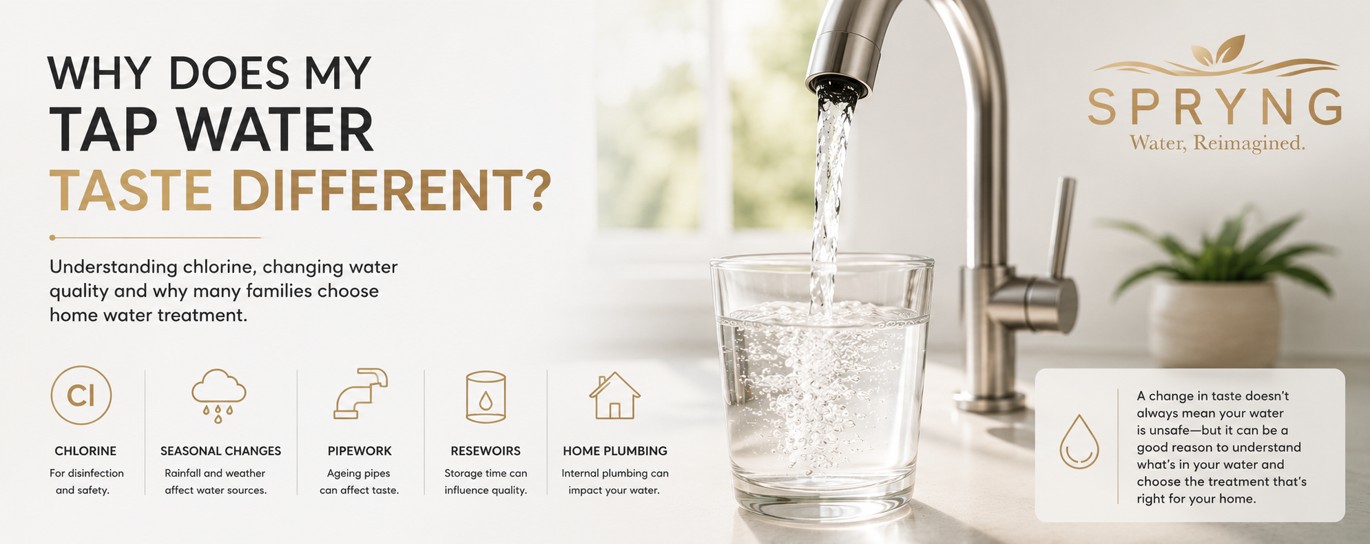
Ever wondered why your tap water sometimes tastes or smells different? Learn why municipal water changes throughout the year, why chlorine is added, and how home water treatment can improve taste and consistency.
Have you ever noticed your tap water tasting different?
One week your drinking water tastes perfectly normal. The next week it has a slight chlorine smell, a metallic taste, or even an earthy flavour after heavy rain.
If you’ve experienced this, you’re not alone.
Many homeowners notice that the taste of their tap water changes from time to time. In most cases, this doesn’t mean the water is unsafe—it simply reflects the journey your water has taken before it reaches your kitchen.
Understanding why these changes happen can help you make informed decisions about your drinking water.
Where does our tap water come from?
Before water reaches your home, it has already travelled a long way.
It is collected from rivers, dams or other water sources, treated at a municipal water treatment plant and then pumped through reservoirs and kilometres of underground pipes before arriving at your tap.
Along the way, its taste and characteristics can change slightly.
Why is chlorine added to drinking water?
One of the most important steps in municipal water treatment is disinfection.
The most common disinfectant is chlorine.
Its job is to destroy harmful bacteria, viruses and other microorganisms that could cause disease.
In fact, chlorination is considered one of the greatest public health achievements of modern times because it has helped make drinking water much safer around the world.
Without chlorine, harmful microorganisms could grow while water travels through the distribution network.
So why can I smell or taste chlorine?
Chlorine is very effective at protecting drinking water, but it also has a distinctive smell and taste.
Some people hardly notice it, while others are very sensitive to it.
You may notice chlorine more at certain times of the year because:
- Municipal treatment levels may be adjusted to suit changing water conditions.
- Heavy rainfall can change the quality of the source water.
- Warm weather can make chlorine odours more noticeable.
- Water may spend longer in reservoirs or pipelines before reaching your home.
The important point is that a noticeable chlorine smell doesn’t automatically mean there is too much chlorine or that your water is unsafe.
Why else can tap water taste different?
Chlorine isn’t the only reason your water may change.
Other factors include:
- Naturally occurring minerals in the water.
- Ageing municipal pipes.
- Plumbing inside your home.
- Storage tanks that are not regularly cleaned.
- Seasonal changes in the source water.
- Temporary maintenance on the municipal network.
These factors can affect the taste, smell and appearance of water even when it still meets drinking water standards.
What are trihalomethanes (THMs)?
You may come across the term trihalomethanes, often shortened to THMs.
These compounds can form when chlorine reacts with small amounts of naturally occurring organic material in the water.
THMs have been studied for many years, which is why water authorities around the world monitor and control their levels as part of drinking water quality management.
For most homeowners, the important point is that municipalities continuously monitor treated water to ensure it complies with drinking water standards.
Why do many people still use a water purifier?
Even though municipal water is treated before it reaches your home, many families choose to filter the water they drink every day.
Common reasons include:
- Improving taste and smell.
- Reducing chlorine.
- Producing consistently fresh-tasting drinking water.
- Reducing many dissolved substances.
- Having greater confidence in the water used for drinking and cooking.
Home water treatment is not about replacing municipal treatment—it is about providing an additional level of purification at the point where you actually use the water.
How do carbon filters and reverse osmosis help?
Different filters perform different jobs.
Activated carbon filters are excellent at reducing chlorine, unpleasant tastes and odours, making water more enjoyable to drink.
Reverse osmosis (RO) provides an additional level of purification by reducing many dissolved substances that ordinary filters cannot remove.
Many modern systems combine both technologies to produce clean, fresh-tasting drinking water.
The bottom line
It’s normal for tap water to taste slightly different from time to time.
Changes in weather, water sources, treatment processes and the journey through the municipal network can all influence what reaches your tap.
A change in taste doesn’t automatically mean your water is unsafe. However, if you prefer water that tastes fresh and consistent every day, home water treatment can make a noticeable difference.
At SPRYNG, we believe the best decisions start with understanding your water. That’s why our systems combine advanced filtration with simple, reliable technology—helping families enjoy great-tasting drinking water, every day.