
A Simple Guide to Total Dissolved Solids in Your Drinking Water.
Learn what TDS (Total Dissolved Solids) means, what a TDS reading tells you, and why it’s useful when choosing a home water purifier.
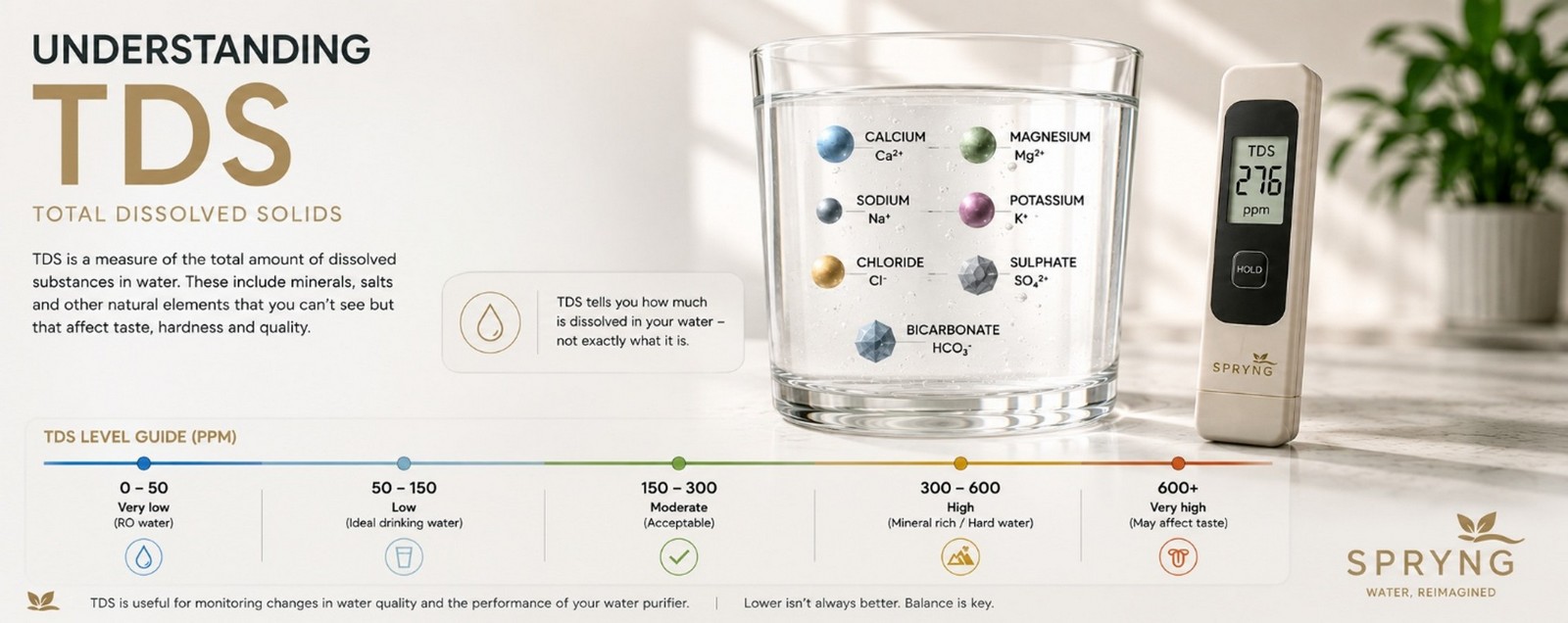
What is TDS?
If you’ve been researching water purifiers, you’ve probably come across the term TDS.
It sounds technical, but the idea is actually very simple.
TDS stands for Total Dissolved Solids.
These are tiny substances that have dissolved into the water. They are so small that you can’t see them, and they won’t settle at the bottom of a glass.
Think about putting a spoonful of sugar into a cup of tea. The sugar disappears, but it’s still there. The same happens with many substances that dissolve naturally in water.
What makes up TDS?
TDS is made up of many different dissolved substances, including:
- Calcium
- Magnesium
- Sodium
- Potassium
- Chloride
- Sulphates
- Bicarbonates
It can also include small amounts of:
- Iron
- Copper
- Nitrates
- Fluoride
- Other naturally occurring minerals
Some of these are completely normal. Others may affect the taste, hardness or quality of the water.
The important thing to remember is that TDS is simply a measurement of everything dissolved in the water.
How is TDS measured?
TDS is measured in parts per million (ppm) or milligrams per litre (mg/L).
For example:
- 50 ppm means there are about 50 milligrams of dissolved solids in every litre of water.
- 300 ppm means there are about 300 milligrams in every litre.
The higher the number, the more dissolved material the water contains.
Is a high TDS bad?
Not necessarily.
This is one of the biggest misunderstandings about water quality.
A high TDS reading does not automatically mean the water is unsafe, and a low reading does not automatically mean the water is healthier.
For example:
A glass of mineral water may have a fairly high TDS because it contains beneficial natural minerals.
On the other hand, water with a lower TDS could still contain contaminants that you don’t want to drink.
TDS tells you how much is dissolved in the water—not exactly what those dissolved substances are.
So why is TDS important?
Although it doesn’t identify individual contaminants, TDS is still a very useful guide.
A TDS reading can help indicate:
- Changes in water quality
- The amount of dissolved minerals in the water
- Whether a reverse osmosis system is working properly
- When a membrane may need attention
Many modern reverse osmosis systems display the incoming and purified water TDS so you can easily see the difference.
Municipal water vs borehole water
Both municipal and borehole water contain dissolved solids.
Municipal water often contains minerals picked up from natural water sources as well as substances used during treatment.
Borehole water usually has a higher TDS because groundwater spends many years moving through layers of soil and rock, dissolving minerals along the way.
This is one reason why borehole water should always be tested before choosing a treatment system.
How does reverse osmosis affect TDS?
Reverse osmosis is one of the most effective ways of reducing dissolved solids.
As water passes through the RO membrane, many dissolved salts, metals and other impurities are separated from the purified water.
This usually results in a significantly lower TDS reading.
That doesn’t mean the goal is to achieve the lowest possible number.
The goal is to produce clean, great-tasting water that is appropriate for everyday drinking.
Some reverse osmosis systems, including selected SPRYNG models, include a remineralisation stage that adds carefully selected minerals back into the purified water for a balanced taste.
Can you judge water by its TDS alone?
No.
A TDS meter is a useful tool, but it cannot tell you exactly what is in your water.
For example, it cannot identify:
- Bacteria
- Viruses
- Chlorine
- PFAS
- Pesticides
- Individual heavy metals
That’s why a laboratory water analysis is always recommended for borehole water and why TDS should be seen as one indicator of water quality—not the whole picture.
Would you add an image
The bottom line
TDS is one of the easiest ways to understand your water, but it’s only part of the story.
It tells you how much is dissolved in the water, not what those dissolved substances are.
Understanding TDS helps you make better decisions about your drinking water and gives you a simple way to monitor the performance of your reverse osmosis system.
At SPRYNG, we believe informed customers make better choices. That’s why many of our systems include a real-time TDS display—so you can see your water quality every day, not just trust what’s inside the machine.