
Learn what microplastics and nanoplastics are, where they come from, why they’re found in drinking water and how reverse osmosis can help reduce them.
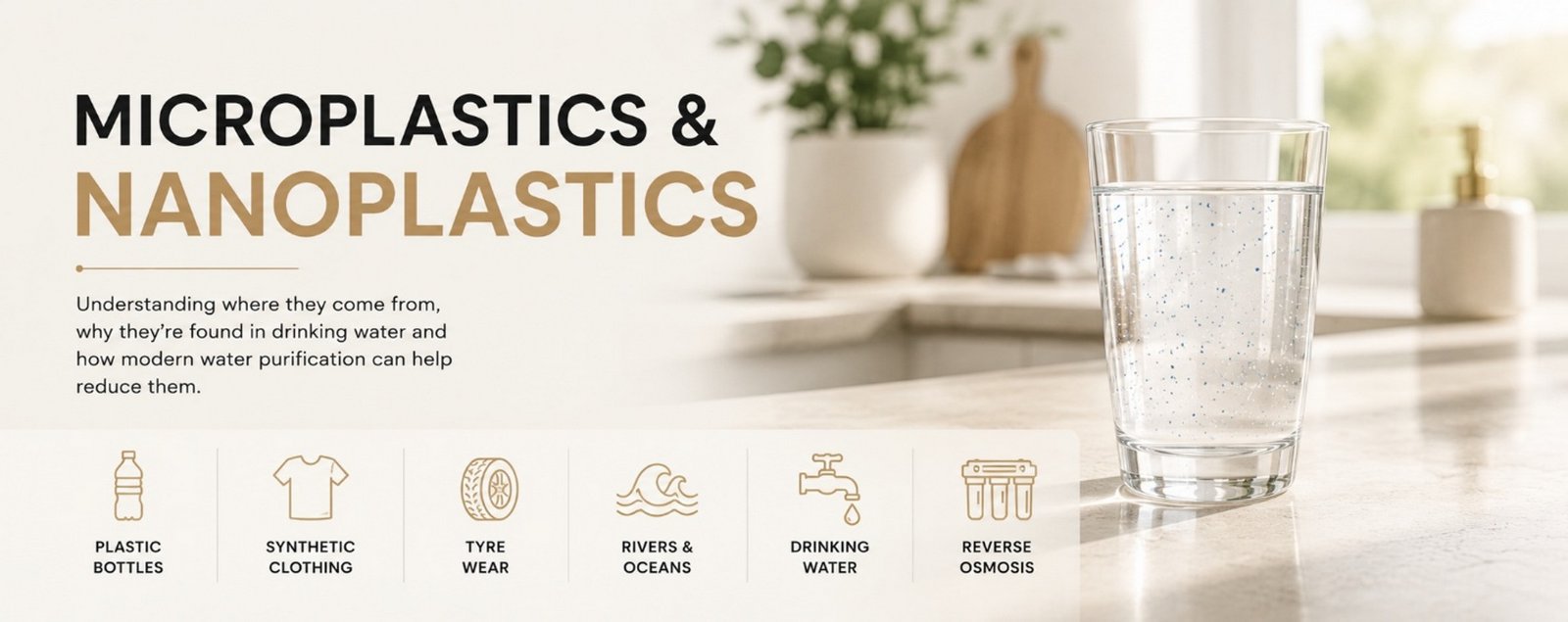
What they are, where they come from and what scientists currently know about them.
You may have heard that tiny pieces of plastic have been found in drinking water, food and even the air we breathe.
These tiny particles are called microplastics and nanoplastics, and they have become one of the fastest-growing areas of scientific research around the world.
But what exactly are they?
Should families be concerned?
And can home water treatment help?
Let’s take a closer look.
What are microplastics?
Microplastics are very small pieces of plastic, usually less than 5 millimetres in size.
To put that into perspective, many are smaller than a grain of rice, while others are almost impossible to see with the naked eye.
They are created when larger plastic items slowly break down over time through sunlight, weather and everyday wear and tear.
What are nanoplastics?
Nanoplastics are even smaller.
They are measured in nanometres, making them thousands of times smaller than the width of a human hair.
Because they are so tiny, scientists are still learning exactly how they behave in the environment and inside the human body.
Research into nanoplastics is one of the newest and fastest-growing fields in environmental science.
Where do they come from?
Plastic has become part of everyday life.
As plastic products age and break down, they release tiny particles into the environment.
Common sources include:
- Plastic bottles and food packaging
- Synthetic clothing released during washing
- Car tyre wear on roads
- Plastic bags and containers
- Fishing equipment and marine litter
- Industrial plastics and manufacturing
Over time, these particles can find their way into rivers, dams, lakes and groundwater.
Are microplastics found in drinking water?
Yes.
Scientists have detected microplastics in drinking water in many parts of the world.
They have also been found in bottled water, rivers, oceans and even rainwater.
The important thing to understand is that finding microplastics does not automatically mean the water is unsafe.
Scientists are still working to understand exactly how much exposure people experience and what the long-term health effects may be.
Should families be worried?
Research into microplastics and nanoplastics is still developing.
While scientists continue to study their possible health effects, many experts agree that reducing unnecessary exposure is a sensible approach, particularly when practical solutions are available.
Governments and researchers around the world are investing heavily in understanding how these tiny particles affect people and the environment.
Can home water treatment help?
Different water filters remove different types of contaminants.
High-quality reverse osmosis (RO) systems are among the most effective home water treatment technologies available and have been shown to significantly reduce microplastics and many other microscopic contaminants from drinking water.
Many modern systems also combine reverse osmosis with activated carbon filtration, helping to improve both water quality and taste.
Why are more families choosing purified drinking water?
For many homeowners, the decision isn’t based on one single contaminant.
It’s about improving the overall quality of the water they drink every day.
Families often choose home water purification to:
- Improve taste and smell.
- Reduce chlorine.
- Reduce many dissolved contaminants.
- Reduce microplastics and other microscopic particles.
- Enjoy consistently fresh drinking water every day.
The bottom line
Microplastics and nanoplastics are becoming an increasingly important topic as scientists learn more about them.
Although research is still ongoing, these tiny plastic particles have now been detected in many parts of our environment, including drinking water.
The good news is that advanced home water treatment technologies, such as high-quality reverse osmosis systems, can significantly reduce microplastics and help provide cleaner, fresher drinking water for your family.
At SPRYNG, we believe the best decisions start with understanding your water. That’s why our systems combine advanced purification with thoughtful design—helping South African families enjoy great-tasting drinking water with confidence every day